Case Study · Haut-Rhin, Alsace
Two Villages in Alsace
Three American records gave three different answers about where the same couple was born. Here is how the Alsatian registers finally settled it, and what the paper trail said along the way.
Nicole wrote to me in the second week of August with a question and a deadline. The question was the one I hear most often: where exactly in Alsace were my great-great-grandparents born? Not the country, not the province. The name of a village, because she wanted to stand in it. The deadline was her flight.
Elizabeth Merck and Joseph Seckler had married in Paterson, New Jersey, on 25 June 1887. That much was certain. Everything after it dissolved on contact.
Three records, three countries of birth
Nicole had gathered three American documents about this couple, and they do not agree with each other.
On the 1887 marriage return, both bride and groom give their country of birth as France. On the 1898 birth record of their son John, the same two people are recorded as born in Germany, and the bride's surname has become Mark. On the 1938 death certificate of Elizabeth, given by that same son, she is French again.
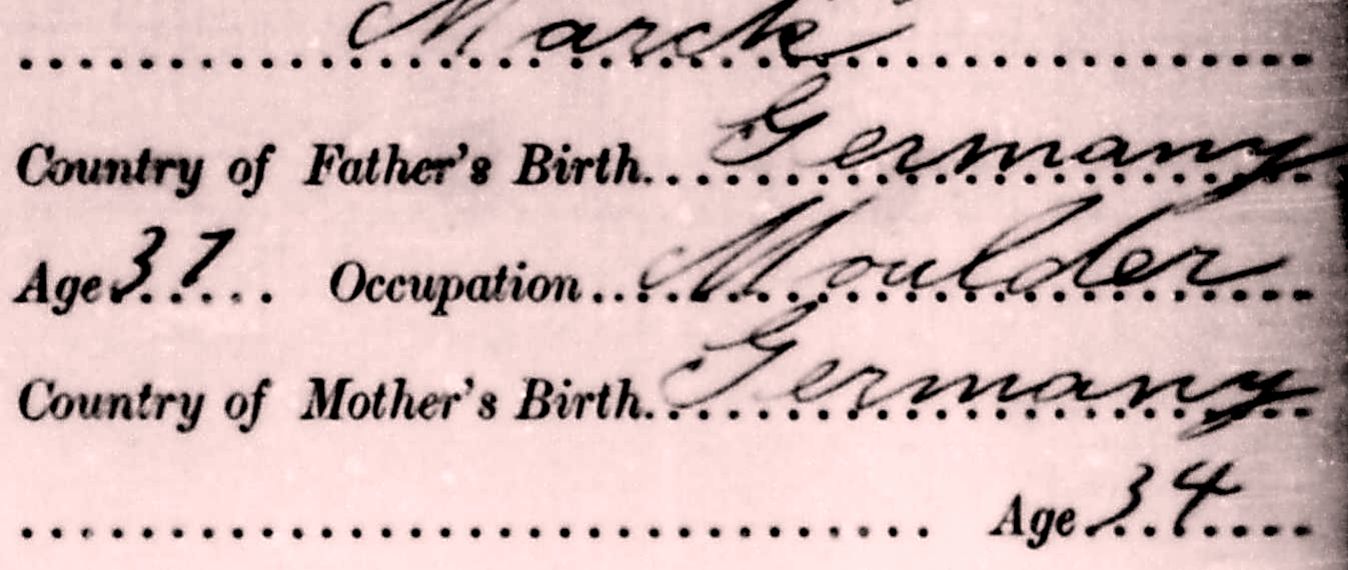
None of this is a lie, and none of it is a clerical accident. It is what Alsatian ancestry looks like from the American side. The couple was born in French Alsace, left after the province was annexed by the German Empire in 1871, and spent the rest of their lives answering a question that had two correct answers depending on the year you asked it. Their surname, meanwhile, was being written down by clerks who had never seen it and were spelling what they heard.
A researcher who does not know this reads the file as contradictory and stops. Nicole did not stop.
What Nicole had already done
This matters, because the value of a professional is easiest to see against good amateur work rather than against nothing. Nicole had done a great deal of it.
She had found an 1866 census for Soultz, in the Haut-Rhin, containing two promising households: Jean Baptiste Merck with Elisabeth Liermann, living on the rue de la Chapelle, with a daughter Élise aged two and a child Charles; and Joseph Seckler with Thérèse Schellenberger, on the rue des Soeurs, with a son Joseph aged four. She had noticed that a Charles Merck signed as a witness at the 1887 wedding in Paterson, and drawn the right conclusion about who he probably was. She had then gone into the Soultz birth registers for 1864 and 1865 and read them by hand.
She found nothing. And she was honest enough to write down why that troubled her, and to flag the one reading in her own file that she did not trust.
Her diagnosis was correct on both counts. The Merck identification held. The Seckler identification was blocked by a contradiction she could not resolve. What she could not know is that neither problem was a problem of research. Both were problems of reading.
Three walls
The year that was wrong by one
Elizabeth's 1938 death certificate gives her birth as 23 December 1864. It is written in clear capitals. It is the kind of detail a researcher treats as solid, and every search had been aimed at 1864 and the months around it.

But look at what that document is. It was completed in 1938, on the statement of her son John, about an event that had happened seventy-four years earlier in a country he had never lived in. Now set it beside three sources created while Elizabeth was alive and able to answer for herself.
| Source | Age stated | Birth implied |
|---|---|---|
| Marriage, Paterson, June 1887 | 23 | June 1863 to June 1864 |
| Birth of her son John, November 1898 | 34 | Nov. 1863 to Nov. 1864 |
| Soultz census, 1866 | 2 | 1863 to 1864 |
| Death certificate, 1938 | born 23 Dec 1864 | the only outlier |
The three lifetime sources overlap on 1863. The single posthumous source points at 1864, and 1864 was the only year anyone had opened. She was born on 23 December 1863. John had remembered his mother's birthday perfectly. He had simply misremembered the year, by one, and that single digit had hidden her for decades.
The name nobody could read
On the 1887 marriage return, the maiden name of the groom's mother had initially been interpreted as Leininger with the help of ChatGPT, but the reading remained uncertain, and it reached me as Liermann. That matched nothing, because the Soultz census gave Joseph's mother as Thérèse Schellenberger. Two different women, apparently, and no way to tell which household was the right one.
So I went back to the original image and enlarged it.

It is not Liermann. It is an English-speaking clerk's phonetic attempt at SCHELLENBERGER, a name he had certainly never seen written down, spoken to him by a young man with a German-speaking Alsatian accent. The Mary in front of it is the same clerk keeping only the first of two given names: Marie Thérèse.
The contradiction that had blocked the entire paternal line did not exist. It was confirmed later, and independently, by the birth act of Joseph's sister Marie at Soultz in 1864, which names the mother Schellenberger Thérèse in full. If you want the general version of this problem, it is the subject of a whole guide to what French surnames do on the way to America.
An index that changes its rules every twenty pages
The third wall produced no ancestor at all, and took the largest share of the work.
The decennial indexes for Soultz form a single volume of 551 images covering 1792 to 1872. It is not one index. It is a stack of tables compiled by different clerks, at different dates, in two languages, using classification logics that contradict each other. Before searching for anything, I had to establish how the volume was built: that within each ten-year block the series run births, then deaths, then marriages, which is unusual; that some tables are sorted by year and then alphabetically while the post-1871 German ones are sorted by letter and then by year; that the Sch- block is sometimes filed in its alphabetical place and sometimes thrown after every other S, and that the rule changes from one year to the next under the same compiler; that the dates in these tables are sometimes the date of the act and sometimes the date of the event; and that names get added out of sequence in whatever blank space was left, which makes any conclusion of absence dangerous.
Hours of that produced not a single name. It also made everything that followed possible. Mapping the index is part of the job, and it is the part nobody photographs.
The search itself
The ghost entry
The first Merck I found in the Soultz tables was a line reading Merck Marie Thérèse, 11 January 1866. Right name, right window. I opened the birth register at that date.
There was nothing there. No act on 11 January at all. The register jumped from the ninth to the sixteenth.
The temptation is to call that a copying error and move on. But another entry on the same page, Meyling Marie Anne, 2 January 1866, was equally impossible. One impossible entry is a mistake. Two impossible entries mean you are reading the wrong index. I was in the table of deaths, not births. The Merck child of 11 January 1866 had died, not been born.
That detour cost several hours. It also produced the rule that carried the rest of the day: read the heading of the table before you read a single line of it.
An online tree that was half right
Unsourced collaborative trees put Jean Baptiste Merck's birth at Rimbach-Zell, a hamlet of about two hundred people five kilometres above Soultz. So I tested it. I read every annual birth table for Rimbach-Zell from 1863 to 1868: seventy-six births, twenty-six surnames, not one Merck. In a village that closed, where six families produce most of the children, that absence means something.
Elizabeth was not born there. But the claim had never been about her. It was about her father, and those are two different questions that the online tree had quietly merged into one. So I opened Rimbach-Zell for 1833, the year the tree gave for him.
The act was there. Jean Baptiste Merck, born 8 November 1833 at nine in the evening, son of Jean Baptiste Merck, day labourer, and Rose Ehlinger. The tree had been right about the fact and wrong about what followed from it, which is exactly how that kind of source should be treated: a hypothesis worth testing, never a proof worth copying.
Elizabeth
The German table compiled after the annexation, Gemeinde Sulz 1863-1872, is a genuine decennial index sorted by letter and then by year, which puts every Merck of the decade in one place. Two lines mattered:
Decennial index, Gemeinde Sulz, 1863-1872 MERCK · Marie Élisabeth · 1863
MERCK · Charles · 11 February 1866
The date column of that table is badly aligned and my first reading sent me to 13 December, which does not exist. The twenty-third does.
Soultz, act no. 221, 23 December 1863 Declaration made at the town hall of Soultz on the twenty-third of December eighteen hundred and sixty-three, of the birth of a child of the female sex, born in lawful wedlock this day at one o'clock in the morning, at the home of its father and mother, and named Marie Élisabeth.
Father: MERCK Jean Baptiste, factory worker, aged thirty years.
Mother: LIERMANN Élisabeth, no occupation, aged twenty-nine years.
The father is thirty years old. The Rimbach-Zell act has him born on 8 November 1833. On 23 December 1863 he was thirty years and forty-five days. The chain closes with no hypothesis left in it.
A mistake, caught and corrected
On the Seckler side I first concluded that no Seckler had been born at Soultz between 1859 and 1862. That result was wrong. I had made it in the table of deaths rather than births, which is precisely the error the ghost entry had already taught me to avoid a few hours earlier.
I redid the test in the right section, year by year, writing down the sequence of surnames on either side of where a Seckler should have fallen. The conclusion turned out to be the same. The difference is that the second time it was worth something.
Joseph
His parents had not married at Soultz either. Here an old rule of French law does the work of an hour of searching: a marriage is celebrated in the commune of the bride. Find where Thérèse Schellenberger came from, and you find the marriage.
An online tree mentioned a Catherine Schellenberger born in 1838 at Wuenheim, the next commune over. Probably a sister. I read the Wuenheim marriage tables from 1853 to 1861:
Wuenheim, 27 October 1859 SEKLER François Joseph and SCHELLENBERGER Thérèse
And that act gave up the decisive fact. The groom was domiciled at Buhl. The banns had been published at Buhl and at Wuenheim. The household lived at Buhl, not Soultz. Which is why nobody had ever found Joseph in the Soultz registers, and never would have.
The Buhl birth tables gave Émile in 1860, nothing in 1861, and then:
Buhl, act no. 31, 19 June 1862 Appeared Joseph SECKLER, moulder, aged thirty-two years, who presented to us a child of the male sex, born in his house in this commune, this day at nine o'clock in the morning, of himself and of Thérèse SCHELLENBERGER, his wife, to whom he declared he wished to give the given names of Joseph Eugène […] after the act had been read and interpreted to them in German.
Joseph declared himself twenty-five years old at his wedding in Paterson on 25 June 1887. Born on 19 June 1862, he was twenty-five years and six days.
The answers
“Elizabeth Merck” · “Lizzie Mark”
at her parents' home
“Joseph Seckler”
in his parents' house
Seven kilometres apart. They married twenty-five years later, six thousand kilometres away.
The full report
Seven generations, five villages, and every archive reference
The document Nicole received: both birth acts in full, the Merck line back to a winegrower born around 1767, the Seckler line back to Wattwiller, the collateral families opened along the way, and the archive reference for every act cited. This is what a Racines report looks like.
Read the full report →
What this research teaches
Ages given in life beat dates carved after death
A death certificate is written by a survivor, sometimes decades later, about a country they may never have seen. An age given at one's own wedding is given by the person concerned. When the two disagree, the living witness wins.
A blocking contradiction is usually a reading problem, not a fact problem
The name that matched nothing was the right name, badly spelled by a foreign clerk. Before concluding that two records describe two different people, make sure you have read both of them correctly.
Online trees are hypotheses, and good ones
Two unsourced claims steered this research, and both proved accurate once the act was found. Copying them would have been a mistake. So would ignoring them. Test, then cite the act, never the tree.
Mapping the index is part of the work
A substantial share of the hours produced no ancestor whatsoever. It went into understanding how a 551-image volume was assembled. Skip that step and the searches that follow return false absences, which are worse than no answer at all.
A rule of law is a research tool
A marriage is celebrated in the commune of the bride. That one sentence found two marriages that were otherwise invisible, and through them, two villages.
Say where you looked, especially when you found nothing
And when you get it wrong, say that too. I searched the wrong section of a register in this very file, which is why you have just read about it.
The street
There is a detail in the 1866 census that neither of us thought much about at first. The Merck household is recorded on the rue de la Chapelle in Soultz.
The registers then filled that street in. Elizabeth's great-grandfather Jean Merck was a vigneron, a winegrower, at Soultz around 1807, and so was her other great-great-grandfather Jacques Liermann. Both men served in turn as the mayor's official witnesses at the town hall. Their sons became day labourers. Their grandchildren, Jean Baptiste Merck and Élisabeth Liermann, are both entered in the registers as ouvrier and ouvrière de fabrique, factory hands. They almost certainly met at the mill. Three generations from the vine to the factory, and one more to cross the Atlantic.
When I sent Nicole the report, she went looking at Soultz on a map. She found a working winery on the rue de la Chapelle, and wrote to say she and her mother were going to visit it.
She had picked the street because her family had lived on it. She did not yet know that they had made wine for a living, on that street, for at least three generations before the mill took them. She will be standing in the right place for a reason she had no way of guessing.
“You should have seen my reaction when I realized not only that my great-great-grandmother really was from Soultz all along, but that my great-great-grandfather was born only a few miles up the road in Buhl.”
Nicole and her mother have five villages to visit, all of them within eight kilometres of each other at the mouth of the Florival valley: Soultz, Buhl, Rimbach-Zell, Wuenheim, Wattwiller. You can walk the whole thing in two days.
Ten days earlier, all they had was the word France on a marriage certificate.
Your family has a village too
I'm a French native based in the United States, and this is what I do: take a family name in America and follow it back to the parish register it came from. Right now, before my professional launch, I'm researching a small number of families completely free of charge.
Join the Founding Families listFrançois is a French-born genealogist living in the United States. He traced his own family's history, and its old stone mill, back to the 1500s through the French archives, and now helps American and Canadian families do the same. New to French research? Start with the complete guide to tracing your French ancestry. Related reading: was your ancestor French or German · finding your Alsatian ancestors · finding your ancestor's village · reading old French handwriting · the free French archives online.